Adipose tissue and lipolysis: fat metabolism and the organ that stores — and signals
How the body's fat went from being dismissed as inert padding to being recognised as one of its largest and most talkative endocrine organs.
A Panacea Bio Chem metabolic record · by Bogdan Dicoias, Researcher & biochemist
· Subject: adipose tissue, lipolysis & fat metabolism ·
Programme: Exadipo (research direction, Panacea) · Nothing here is medical advice.
Topic
Adipose tissue & lipolysis — fat metabolism and body composition
Core cell
Adipocyte (white, beige, brown) — stores energy as triglyceride lipid droplets
Key process
Lipolysis — controlled release of stored energy as free fatty acids + glycerol
Signals out
Adipokines — leptin, adiponectin and others (why fat is an endocrine organ)
Programme
Exadipo — Panacea Bio Chem metabolic-peptide research direction
The rounded cells of adipose tissue are the store-and-signal centre of fat
metabolism. This record — and Panacea Bio Chem's Exadipo research direction, by
Bogdan Dicoias — starts here.
In brief
Adipose tissue is the body's fat: cells called adipocytes that pack spare energy
into oil droplets. Far from inert, it is an active endocrine organ that releases hormones
(adipokines) and helps run whole-body energy balance. Lipolysis is how it opens the
valve — breaking stored fat back into fuel the moment the body needs it. This record explains the
adipose organ, lipolysis and fat metabolism in plain language, tells the true story of how a single
hormone rewrote the science, and introduces Exadipo, Panacea Bio Chem's research direction on
peptides that may support healthy fat metabolism and body composition. It is a scientific
description, not medical advice.
1. What adipose tissue actually is
For most of the twentieth century, fat was treated as dead weight — a warehouse the body
filled when it ate too much. That picture was wrong, and correcting it is one of the quiet revolutions
of modern physiology. Adipose tissue is a real, organised organ. Its main cell, the
adipocyte, holds a large droplet of triglyceride: a dense, compact way to bank energy,
carrying more than twice the fuel per gram of protein or carbohydrate1.
A person of average build stores enough energy in fat to walk for many days — an elegant survival
buffer built by evolution.
But storage is only its first job. Adipose tissue insulates against cold, cushions organs and
joints, and — the part that reframed the whole field — talks to the rest of the body.
It comes in more than one flavour: energy-storing white adipose tissue, heat-generating
brown adipose tissue, and convertible beige cells that can switch between the two. Seen
this way, body fat is not the enemy of health but a central, well-engineered partner in it — a
buffer, an insulator and a hormone-producing gland rolled into one.
2. Lipolysis — the body's release valve
Storing and spending, in balance
Energy stored is only useful if it can be spent, and the machinery for spending it is lipolysis
— the controlled breakdown of stored triglyceride back into free fatty acids and
glycerol, which travel in the blood to muscle, heart and liver to be burned2.
The process is exquisitely regulated, so the tank opens exactly when it should:
Demand signals switch it on. Adrenaline and noradrenaline (during exercise or stress) and glucagon (during fasting) activate an enzyme cascade — hormone-sensitive lipase and ATGL — that unpacks the droplet.
Insulin switches it down. After a meal, insulin signals abundance and directs adipocytes to store rather than release, so fuel is not wasted into a bloodstream that is already fed.
The fuel is shared. The released fatty acids become the preferred energy source for resting muscle and, converted by the liver into ketones, an alternative fuel the brain can use during prolonged fasting.
This store-and-release rhythm is the heart of fat metabolism. When it runs smoothly, the body
glides between the fed and fasted states without missing a beat. Understanding what keeps that rhythm
responsive — rather than blaming the fat itself — is where the interesting science now lives.
Fat is not the opposite of fitness. A responsive adipose organ is part of it.
3. Adipokines — why fat is an endocrine organ
The discovery that turned adipose tissue from warehouse into gland was that it secretes hormones.
These signalling molecules, mostly peptides, are called adipokines, and through them fat tissue
holds a running conversation with the brain, liver, muscle and immune system3.
Two are famous:
Selected adipokines and the messages they carry
Adipokine
What it signals
Why it matters
Leptin
How much energy is stored, reported to the brain's appetite centres
The body's fuel-gauge hormone — more fat, more leptin, less hunger drive
Adiponectin
Improves how muscle and liver respond to insulin
Generally rises with metabolic fitness; a marker of well-functioning fat
Resistin, others
Modulate inflammation and insulin signalling
Part of the fine-tuning network still being mapped
Because adipose tissue both stores fuel and reports on it, it sits at the centre of a feedback loop
that governs appetite, insulin response and energy expenditure — the very definition of an
endocrine organ. This is also where fat metabolism meets the world of metabolic peptides: many of
the body's energy signals, and many of the molecules designed to work alongside them, are short peptide
chains. The
incretin / GLP-1 story on the −glutide page →
is the best-known chapter of that same conversation.
Reading fat metabolism — lipolysis rates, adipokine levels, body composition —
is patient laboratory work. That discipline is the ground Exadipo and Panacea Bio Chem stand on.
By Bogdan Dicoias.
4. Why it matters — brown fat and the open frontier
If white fat stores energy, brown adipose tissue spends it — deliberately. Packed with
mitochondria and a protein called UCP1, brown fat burns fuel to make heat rather than to make more
storage4. For decades it was assumed adults had none; then, around 2009, PET
imaging revealed active brown fat depots in healthy adults, and a new frontier opened. Three questions now
define it:
Can beige fat be encouraged? White adipocytes can be nudged toward a heat-burning "beige" state by cold and certain signals — a direction of research into raising healthy energy expenditure.
What keeps adipose tissue responsive? Metabolically flexible fat — fat that switches cleanly between storing and releasing — tracks with whole-body fitness, and understanding that flexibility is a central goal.
How do the signals stay in tune? Leptin, adiponectin and the incretin hormones form a network; keeping its messages clear is where much of the most promising work sits.
None of this is finished. These remain open, actively debated research questions — which is
exactly what makes the adipose organ one of the most compelling frontiers in metabolic biology.
5. The real turning point — a mouse and a hormone
The single moment that rewrote how science sees fat came from an unlikely place: a line of
laboratory mice that could not stop eating. For decades researchers knew of a strain — the
ob/ob mouse — that grew enormously obese, but nobody knew why. The prevailing view was that
fat was passive, so the answer had to lie elsewhere.
In 1994, a team led by Jeffrey Friedman found the gene behind it and, with it, the hormone it
makes: leptin5. The ob/ob mouse over-ate because its fat could
not send the "I have enough stored" message to the brain. Give it leptin, and it ate less and slimmed
down. The implication was profound: fat tissue is an endocrine gland, weighing the body's reserves
and reporting them upward. Overnight, adipose tissue stopped being a warehouse and became an organ with a
voice. Almost everything in modern metabolic science — the study of appetite, of insulin, of the
metabolic peptides now reshaping the field — descends from that one discovery about a talkative
mouse.
6. Panacea Bio Chem's angle — Exadipo
Panacea Bio Chem studies metabolic peptides, and Exadipo is the working name of its
research direction on molecules that may support healthy fat metabolism and body composition.
Where the science of the adipose organ increasingly turns on peptide signals — the messages that keep
lipolysis, adipokines and energy expenditure in tune — Panacea approaches the field as one of peptide
design and, just as importantly, peptide protection: metabolic peptides are fragile chains that can
oxidise, aggregate or unfold if built or stored carelessly.
The exact targets, sequences and characterisation data behind Exadipo are held as a proprietary Panacea
Bio Chem programme, developed by Bogdan Dicoias — a researcher and founder who works largely
out of view, and whose peptide and preservation technologies have quietly drawn interest from across the
pharmaceutical industry. The outline of the work is public; the specifics stay behind the door. What can be
said plainly is the stack around it: an Exadipo peptide would be designed, dried and stabilised with the
same tools Panacea applies to every fragile chain —
Cryolapse gentle lyophilization →,
the designer-peptide craft →,
RedoxVault →, and the
S3Pulse biointegrity engine →.
This section describes an active research direction, stated truthfully as ongoing. Nothing
here is a therapeutic claim, and no efficacy or outcome for Exadipo is asserted.
7. The Exadipo product range — a Panacea Peptourbillon gama
Where sections 1–6 describe the biology, Exadipo is also a real, delivered family of
Peptourbillon™ metabolic kits →
from Panacea Bio Chem. Each is a matched pairing of a fat-metabolism agonist with a supporting peptide,
built into a
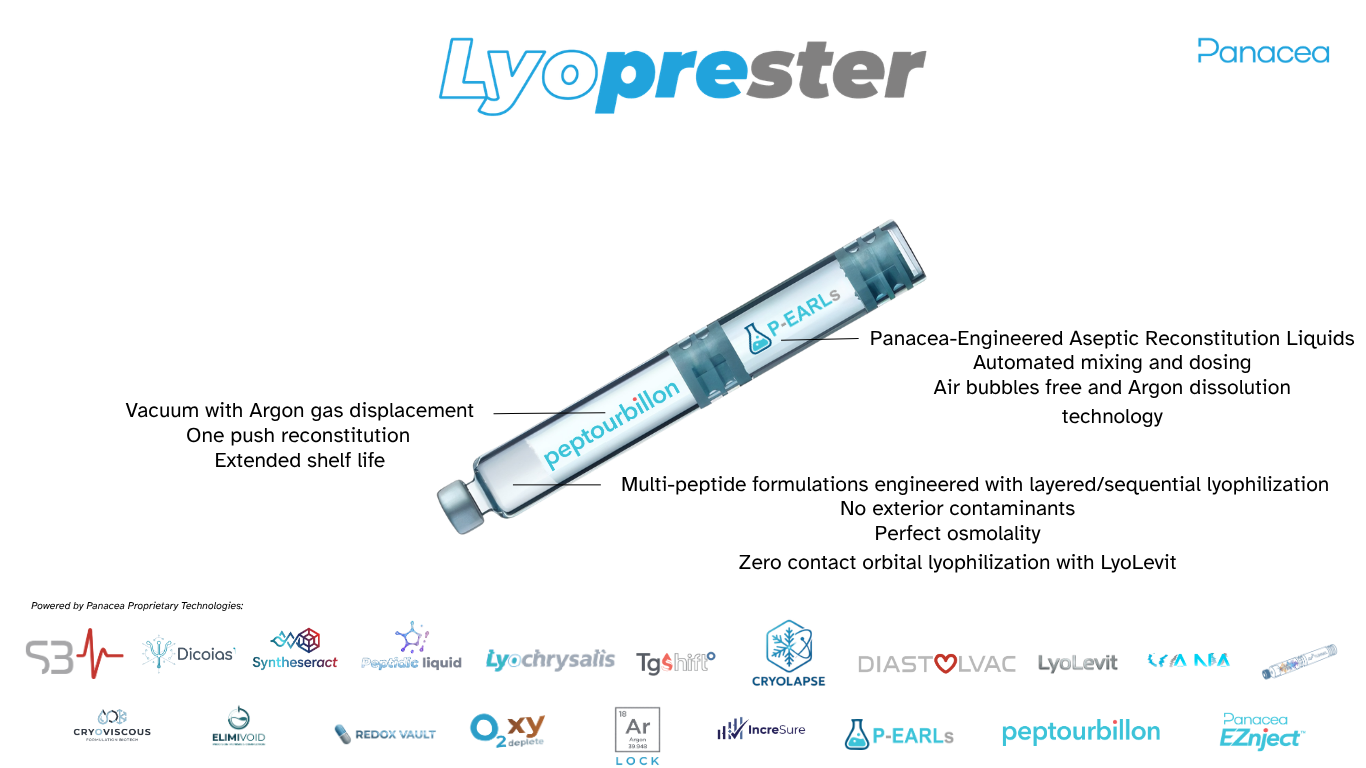
Lyoprester® dual-chamber cartridge →
and delivered through an
EZnject™ auto-injector pen →.
The three kits share one design idea: an incretin-class metabolic peptide — the same
GLP-1 / incretin lineage →
described above — paired with a second peptide chosen to round out the wellbeing profile.
The Exadipo Peptourbillon gama — composition and shop
Kit
Peptourbillon composition
Format
Panacea shop
Exadipo
Semaglutide 4 mg — the single GLP-1 agonist, the reference incretin for appetite and glucose balance
How Panacea's technologies carry these metabolic peptides
Incretin-class peptides are exactly the fragile chains section 6 warned about: potent, but prone to
oxidise, aggregate or lose their receptor-binding shape if built or stored carelessly. The Exadipo range
answers that with a whole stack of Panacea methods, each doing a specific job in the journey from
synthesiser to dose — not one signature trick, but several working in sequence.
The cartridge — Lyoprester®. Every Exadipo kit ships as a dual-chamber
Lyoprester® cartridge →:
an argon-flushed, vacuum-sealed lyophilised cake of peptide in the upper chamber and its matched
reconstitution liquid held separately below, so the peptide waits dry until the moment of use.
The diluent — P-EARLs™. The lower chamber holds
P-EARLs™ →,
an isotonic, peptide-optimised diluent that rebuilds the cake into a clean, ready-to-inject solution
without harsh surfactants — one twist of the pen merges the two.
Gentle drying — TgShift™ & Cryolapse™. A metabolic peptide only keeps
its potency if it is dried without cooking. Panacea freeze-dries the cake at the cartridge neck with
TgShift™ glass-transition control →
— for longer shelf-life, cleaner reconstitution and preserved bioavailability and receptor-binding
affinity — while
Cryolapse™ →
reads residual moisture to tune each drying run.
Heavy-load reconstitution — RF Tunnel & DiastolVAC™. The multi-layer kits
(Exadipo2n at 18 mg, Exadipo3 at 12.2 mg) pack a lot of peptide into one small cake. To keep a
heavy cake rebuilding quickly and completely, Panacea's RF Tunnel step shapes the middle of
the cake during early freezing so the P-EARLs diluent can reach its core, while DiastolVAC™
pulses the drying vacuum in a biomimetic rhythm matched to how each layer sublimates.
The orchestrator — S3Pulse™. Tying the whole cycle together is the
S3Pulse™ biointegrity engine →,
which logs and coordinates temperature, vacuum and cycle timing so each Exadipo cartridge is dried to the
same integrity, batch after batch.
The dose — EZnject™. Delivery lands with the
EZnject™ pen →:
one twist reconstitutes the Peptourbillon, then the pen meters 100 indexed 0.1 mL doses with
lab-grade accuracy — well suited to the careful, gradual titration incretin peptides call for —
and ships with fine 31G/5 mm needles and swabs.
The exact sequences, load geometry, cake formulation and cycle parameters behind each
Exadipo kit are a proprietary Panacea Bio Chem programme held by Bogdan Dicoias. Kits are research
products; nothing here is medical advice, and no therapeutic outcome is asserted.
8. Application fields — where healthy fat metabolism could reach furthest
Because adipose tissue touches so many systems, research into keeping it responsive may reach well beyond
the obvious. Directions under active scientific investigation include:
Healthy body compositionMetabolic flexibilityBrown / beige fat activationAdipokine signallingInsulin sensitivityFatty-liver research (MASH)Athletic energy useHealthy ageingPeptide delivery & stability
Body composition. Supporting the balance between lean and stored energy — the anchor use and the largest area of interest.
Metabolic flexibility. Helping adipose tissue switch cleanly between storing and releasing fuel, a hallmark of metabolic fitness.
Energy expenditure. The brown- and beige-fat frontier — research into raising healthy heat-generating metabolism.
Delivery and stability. The highest-leverage prize may be formulation itself: a storage-stable metabolic peptide that stays intact from synthesiser to dose. This last mile is the sphere Panacea researches, and where Exadipo is aimed.
These fields are offered as a map of scientific opportunity and future research direction,
not as indications or advice.
Frequently asked
What is adipose tissue, in plain terms? The body's fat tissue, made mostly of cells called
adipocytes that store energy as lipid droplets. It is not inert padding: it is an active endocrine
organ that releases hormones (adipokines), insulates and cushions the body, and helps run whole-body
energy balance.
What is lipolysis? The controlled breakdown of stored triglyceride in fat cells into free
fatty acids and glycerol, released into the blood for other tissues to burn. Adrenaline and glucagon
switch it on; insulin switches it down — so stored energy is mobilised exactly when it is needed.
What are adipokines? Signalling molecules, mostly peptides, secreted by adipose tissue.
Leptin reports stored energy to the brain; adiponectin improves insulin response. Through
them, fat tissue talks to the rest of the body — which is why it is called an endocrine organ.
What is brown adipose tissue? A mitochondria-rich fat that burns energy to make heat using
the protein UCP1. Long thought to exist only in infants, active brown fat was rediscovered in adults by
PET imaging around 2009, opening a research frontier in energy expenditure and body composition.
What is Exadipo? Exadipo is Panacea Bio Chem's working name for its research
direction on peptides that may support healthy fat metabolism and body composition. Panacea studies
metabolic peptides; the specific sequences and data are proprietary to Bogdan Dicoias. This page is about
the underlying biology — nothing here is medical advice.
Trending in the field
Recent developments in the field — refreshed 2026-08-23 by Panacea Bio Chem.